▶️ Which research methods should I use and when?
In 2022, Erica Hall created a Design Research Framework, that can be pretty useful to you. This framework is like a checklist, that helps you to make sure that your project starts in the right direction.
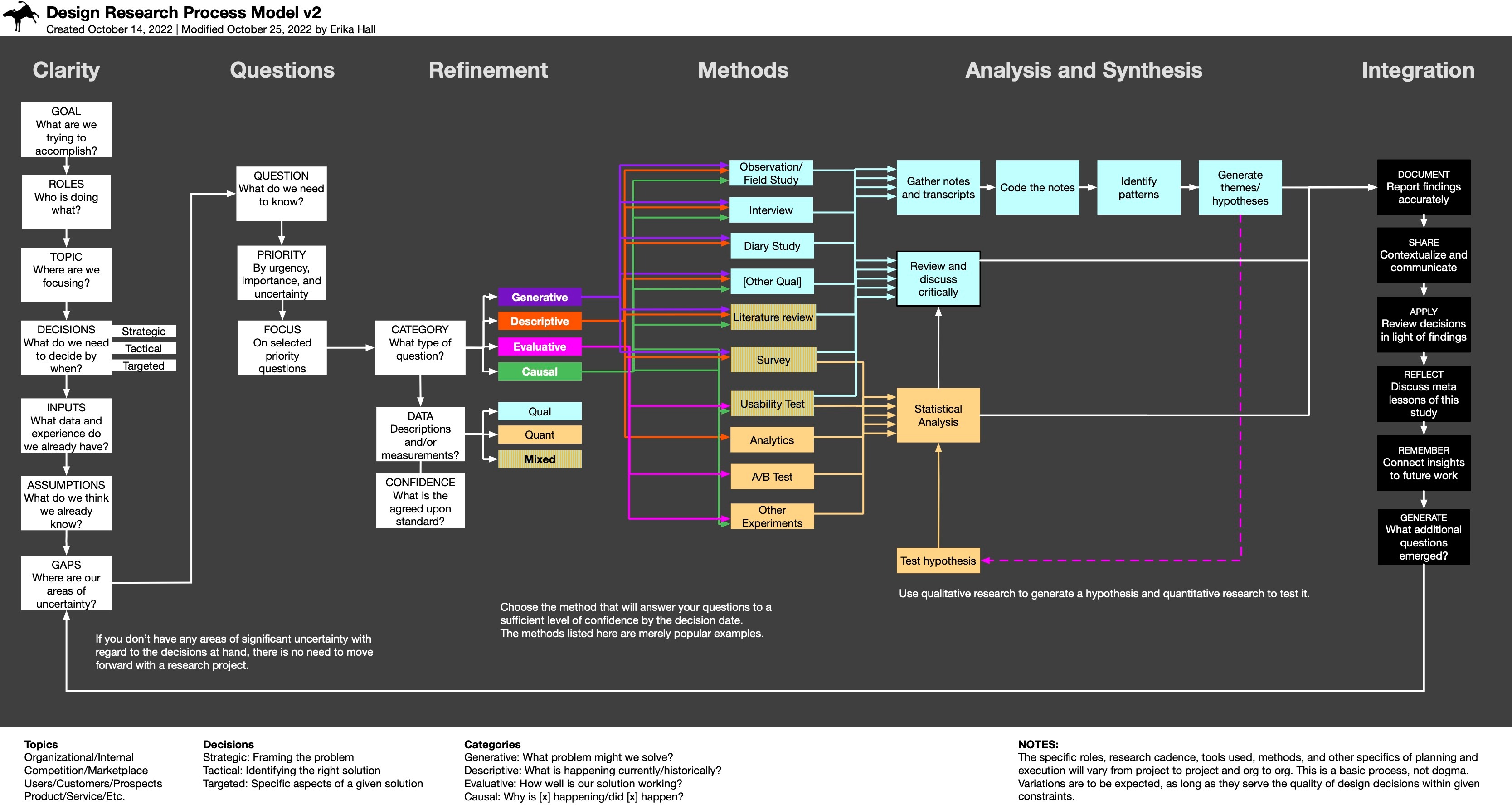
Here are four things that I find particularly interesting in that framework:
Clarifying questions
Methods classification
Synthesis can be done in a short or long path
The report is not the end
You can find in Erika's original blog post a detailed description of the framework, alongside a downloadable PDF.
Clarifying questions
The first thing that I really like about it is that it starts by clarifying what you want to achieve with your research.
It asks you questions like:
What are we trying to achieve?
What data and experience do we already have?
What do we think we already know?
These questions and others help you to make sure that you don't start from scratch, but instead focus on what you really want to know with this research without reinventing the wheel.
Because most of the time there is already research that was done within your organization or outside of it that you can use to inform your research.
Methods classification
The second thing that I really like in this framework is it's categorization of research methods.
In that framework, the research methods are categorized in four categories:
Generative research methods, help us answer the question: What problem might we solve?
Descriptive research methods, help us to answer the question: What is happening at the moment or happened back in the days?
Evaluative research methods help us to answer the question: How well is our solution working for the people we serve?
Causal research methods, help us answer the question: Why is this thing happening or why did it happen?
Showing the short and longer path of synthesis
Another lovely thing that I take out from this research framework is that when you use quantitative methods and you try to make a synthesis of all the information you gathered.
You can either take the long road or the short path.
I find interesting that this framework recognizes that sometimes the synthesis work can be packed up in a much leaner way. Through quicker review and critical discussion.
Instead of going through the much more rigorous, but longer coding of data and insight generation. Obviously the longer road will lead maybe to more mature insights, but
The report is not the end
Finally the framework shows pretty clearly that having a research report doesn't mean that your research is finished.
You still need to do a lot of tiny things, like sharing a report, making sure that people understand it, helping people within your organization, turning this research and these insights into something tangible by applying it. And also like academics love to do at the end of research paper, suggesting what are new questions that will be lovely to have answered with new research.
Which then obviously shows us that this framework can be seen as a continuous loop of research.