Service designers believe services are like icebergs
Service designers believe services are like icebergs

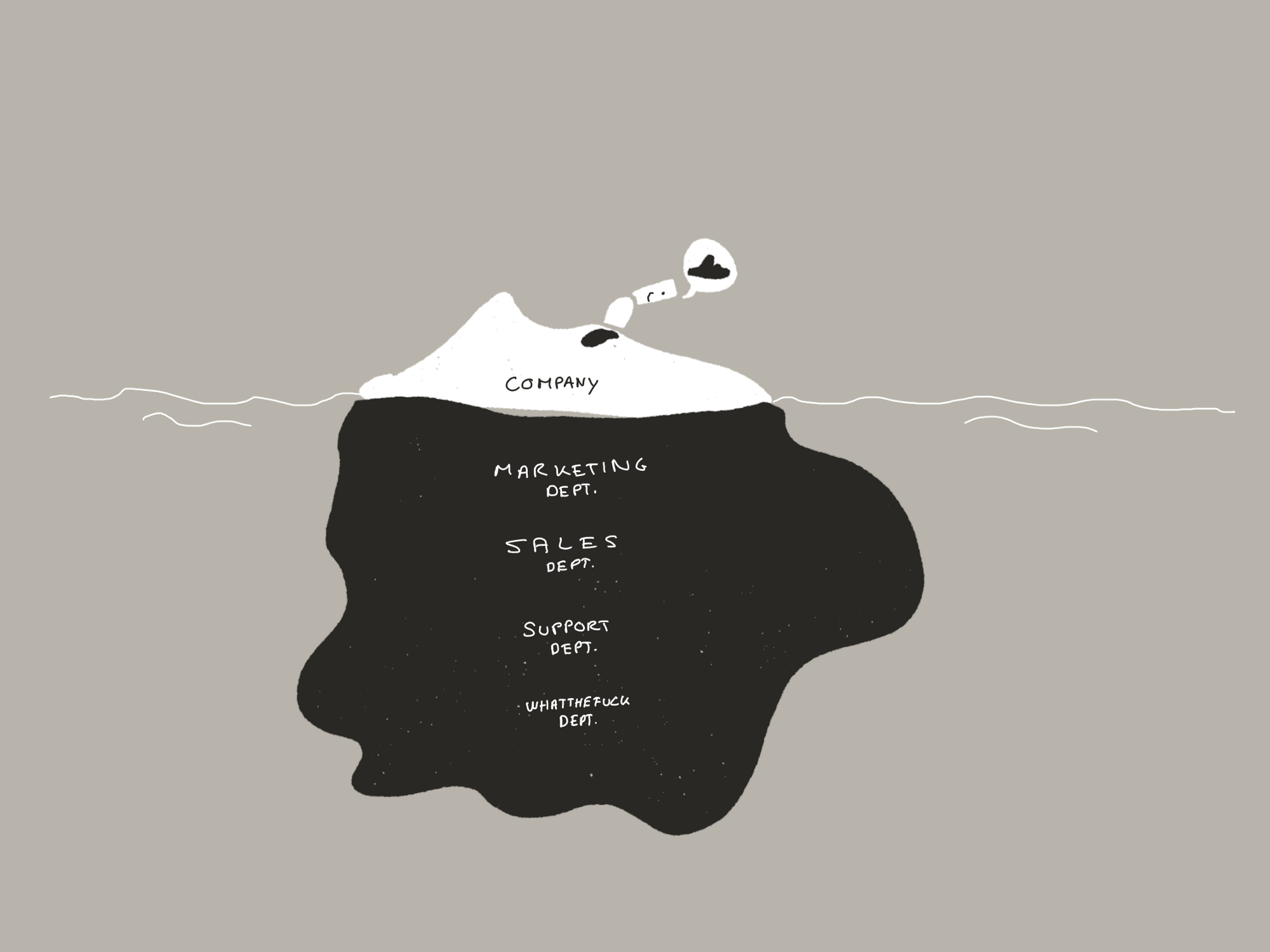
Users often see a service as being a single entity. As a user, when I walk into a shop, I have contact with one brand. I don’t see that there several other departments 😵 within that company that keep this brand afloat. It’s as if customers see only the tip of an iceberg and have no clue that there is still much more going on below.


In service design, we call the visible part of the service the frontstage. The invisible part of the service is what we call the backstage.


Service designers believe that it’s this tension between the structure of the backstage and how users understand the frontstage that often creates frustrations 😢.


How companies build services

The problem is that the hidden part of the service iceberg is built in silos 💔. There is a department that takes care to attract people, which is the marketing department. Then there is a department that sells things to the people. And another department that deals with the queries of the users. 


The problem is that often these silos or departments don’t really communicate 🙊 with each other. This results in gaps between the different departments.


Such gaps between departments are something that many of us have experienced. An ad tells you something about a service or product. When you get to the shop, staff members tell you that the ad was a bit too optimistic. This often happens because the marketing guys in a company didn’t speak with the frontline staff 👨‍🔧.


These gaps between departments create frustrations 🤦‍♂️ for the users. Users believe they are interacting with one organization and not a group of departments that can't speak together.

Free Course: What is the Service Designer mindset?

Buy nowLearn more

About this course

  • Why I created this course
  • What you’ll learn

1. Service designers focus on a human-centered approach

  • Introduction
  • Service designers believe everyone is a user
  • Service designers are not the experts, others are1
  • Recommended course: 100 Service Design Principles
  • Service designers believe perception is key

2. Service designers love to make shit happen

  • Introduction
  • Service designers prototype instead of talking
  • Service designers love to fail
  • Service designers go from low fidelity to high fidelity

3. Service designers are lazy

  • Introduction
  • Service designers steal and adapt tools from smarter people
  • Service designers look for lazy solutions
  • Service designers repackage older ideas
  • Service designers love simple solutions

4. Service designers don’t think in terms of silos but in journeys

  • Introduction
  • Service designers believe services are like icebergs
  • Service designers think in journeys
  • Service designers aren't focused on just one company

5. Service designers deal with uncertainty

  • Introduction
  • Service designers accept that they are weak
  • Service designers understand the phases of a design project
  • They separate divergent from convergent thinking
  • Recommended Article: The Design Process: What is the Double Diamond?3
  • Service designers know that innovation is a mess
  • Recommended Reading: The Design Squiggle Story
  • Service designers know that change needs many steps
  • Recommended Reading: Understanding the Kubler-Ross Change Curve
  • Service designers make step-by-step decisions2
  • Recommended Video: An Introduction to Assumptions Mapping with David J. Bland1
  • Recommended Video: Introducing the Eisenhower Matrix
  • Recommended Reading: How to Use Dot Voting Effectively1
  • Service designers summarize what they learn
  • Recommended Reading: Affinity Diagramming for Collaboratively Sorting UX Findings and Design Ideas
  • Service designers verify what they have learned from different angles

Going further

  • Bravo 👏
  • Resources to go further1
  • 💌 Your next courses and your personal coupon code
  • Thank you!