What's a good note taking system for Design Sprint tests?
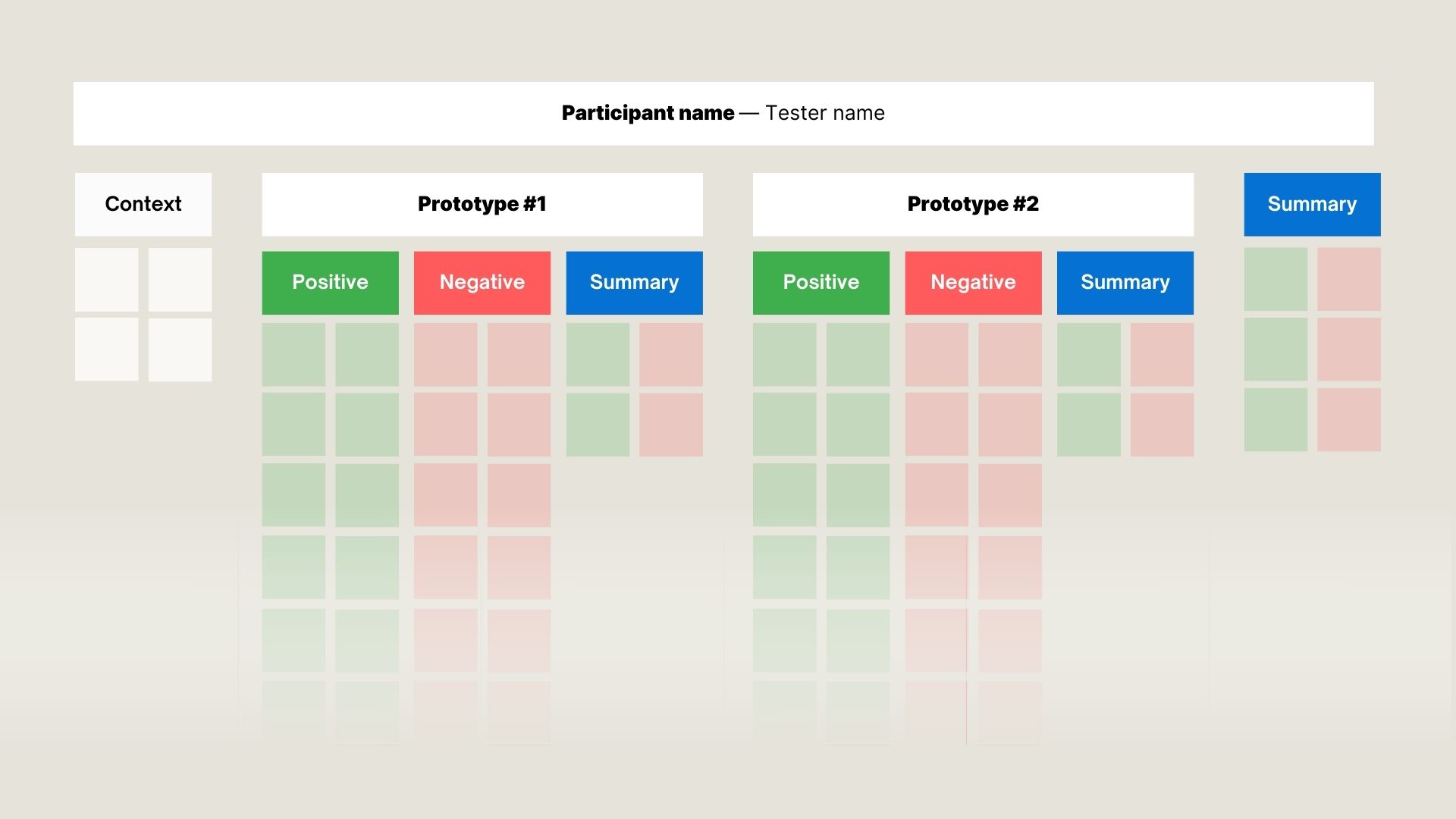
In short: Use a shared whiteboard where testers can use sticky notes to take quick notes. For each prototype use three sections:
Positive feedback: what worked in the prototype?
Negative feedback: what didn't work?
Summary: what are the most important learnings?
For each participant add two overall information blocks:
Context: who was the person you talked to?
Summary: what are the biggest learnings across prototypes?
Why is a good note taking system is important for Design Sprints?
The test phase of a design sprint is the most important phase of the process. All the work done during the sprint leads up to this point. The goal is to have something to test and learn from. The problem is that Design Sprint participants often aren't researchers or designers. So they're not used to run user interviews or to take notes about them.
That’s why a good onboarding for that testing phase is important and a good note-taking system is a big part of it.
What's the base template I use for testing notes in a Design Sprint?
In the Design Sprints I lead, I stick to a simple note-taking structure. I set up a digital whiteboard where each sticky note represents a piece of information. For each prototype tested, the testers collect three types of information:
Positive: This includes what people liked about the prototype, what they understood, and what made sense to them.
Negative: Here, we note down the problems people had, what they didn’t understand, and what didn’t fit into their lifestyle.
Summary: We summarize three to four elements that highlight the most important parts of the feedback—both good and bad.
Additional Sections for Clarity
For each test participant, I also add two more sections that are for information that goes across all the prototypes:
Context: This is where we jot down notes about who the test participant is and their context. It helps us understand where the feedback is coming from.
Summary: At the end, the tester either pick three to four sticky notes as a summary, or writes down the biggest learnings by hand.
Why I like this system
There are three things I really like about this system:
It's super simple: non researchers can use it very easily.
It makes synthesis easy: you can then very easily take all the sticky notes and do some affinity sorting to see if there are recurring problems or recurring opportunities. It's much simpler to manage than if you had a bunch of text that you have to manually break down.
It shows what's most important: by asking the note taker to put the most key elements in the summary you know what was the most important in just a glance.
Made with AI help
This Q&A is based on an audio note I recorded while walking that was then transcribed and re-written using Audiopen. I've then adapt it by hand.