Why you should see a Service Blueprint as a mirror?
In short: Understanding that a service is a mirror between front stage and backstage pushes us to research both sides, test both sides, and to put as much care in both sides.
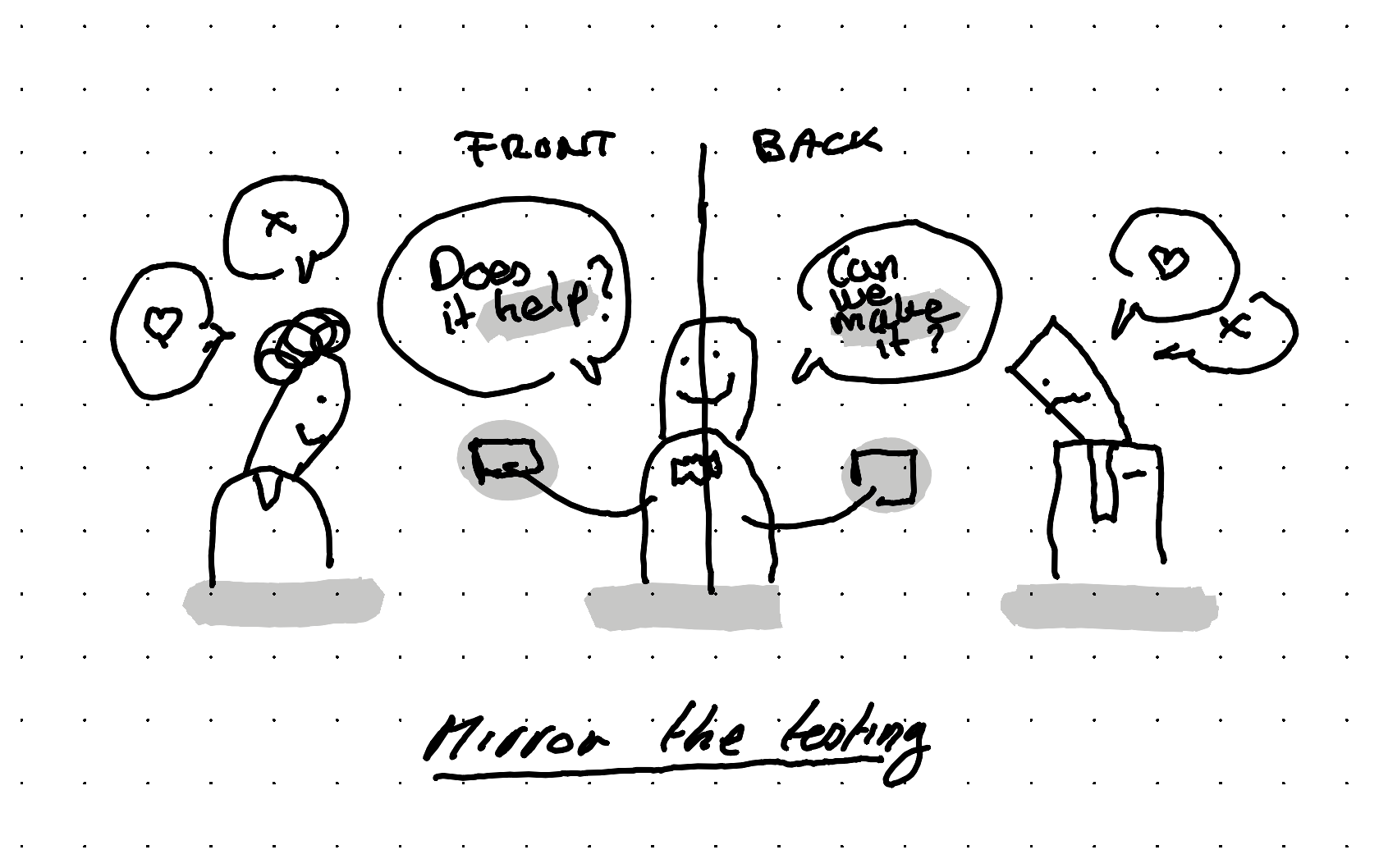
A Service Blueprint is basically a customer journey which has below it what the organization needs to do to make it happen.
I often say that it's a mirror: what goes in one side happens in the other side.
Mirror the blocks
When in a Service Blueprint we capture an important information for the frontstage, we can capture the same information for the backstage.
For example, if we capture the emotional state of the person we serve in the frontstage, we could do the same for the people who run the service.
Having the mirror metaphor here pushes us to have the same level of empathy for both sides.
That works also the other way around. If for the backstage we have quantitiative data to describe key moments, we could have a reciprocity and reflect on what pieces of hard data we could track for the frontstage too,
Mirror the activities
This idea of mirror doesn't apply only to what goes in the Service Blueprint, but can apply to most of the activities of the Service Design professional.
When doing prototyping, testing, research, etc. we can mirror the activities. When we interview one side, we should interview the other side too. When we prototype how something feels for the people we serve, we can prototype how it feels to maintain that for the people who run the service.
A good rule of thumb
The mirror metaphor can help us then have a tiny rule of thumb that we can ask ourselves through out our work:
Am I forgetting one side of the mirror of the service?
Backstage of this article
This article was illustrated on a refurbished Remarkable II tablet and written on the tablet with a folio keyboard.