What are some of the dark sides of Service Design?
In short:
Human centered not planet centered: in a period where we live in a climate crisis, should we really first care about the wishes of the people we serve?
Nature as an invisible backstage: The tools of Service Design aren't natively thinking about nature (like the Service Blueprint).
Machines over humans: by optimizing for self-service, we create a world where we spend more time interacting with machines than humans.
Everything smooth means no effort: by trying to remove all the frictions from experiences we create a "wall-E" like world, where the biggest effort we ask of people is to swipe.
Platforms over personal relationships: platforms that help businesses and individuals meet get too much power and cut the relationships.
Subscription everything: When everything becomes a service things that didn't need to be a subscription suddenly are.
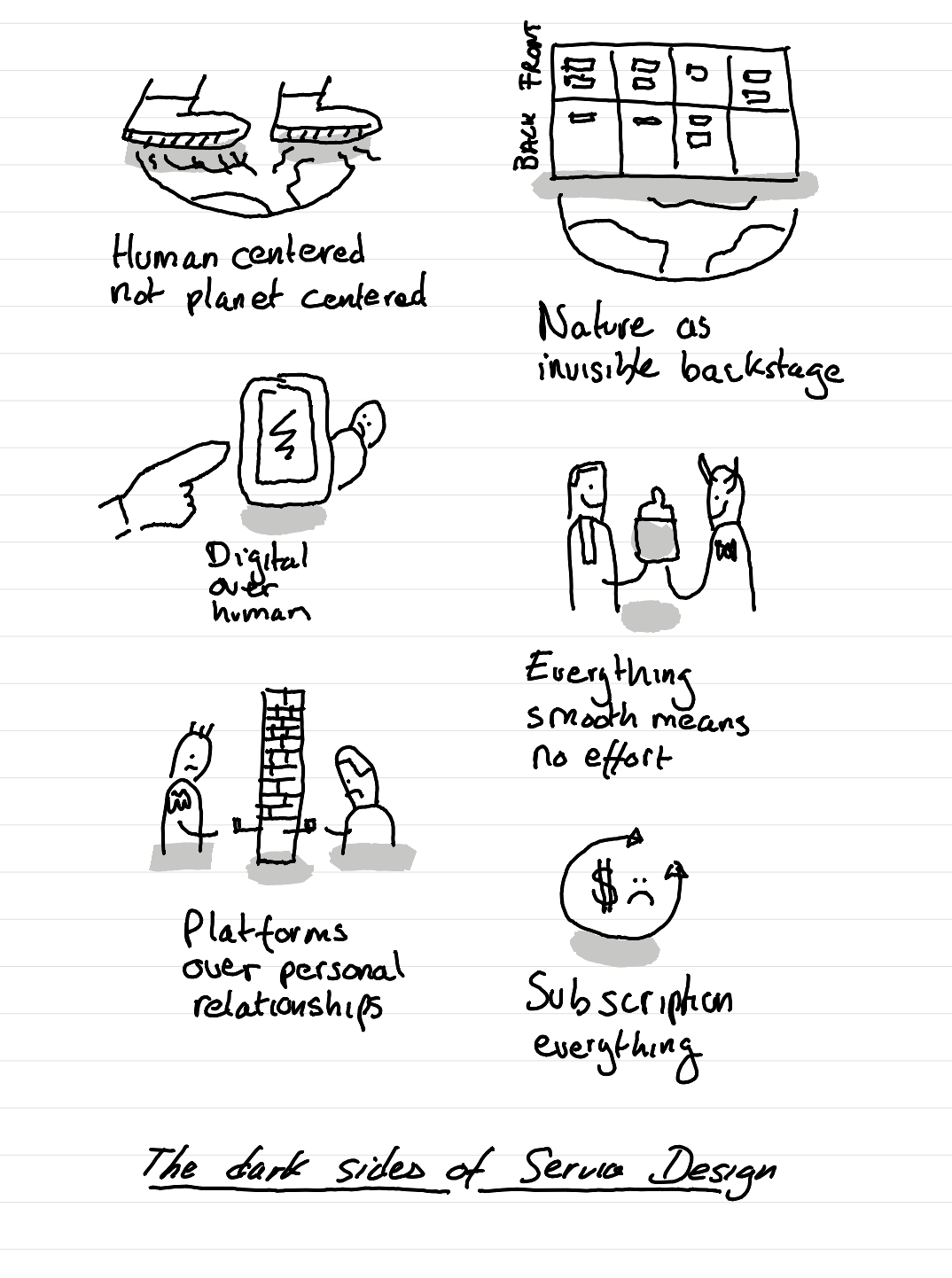
Here are some of the dark impacts that a Service Design practice can have. These are just some, obviously there are more than this. For each I try to also offer an idea of what we can do, to avoid this danger.
Human centered not planet centered
Service Design comes out from a history of human centered design. The twist it adds compared to other human centered design fields is that it looks at both the people who get served and those who deliver the service.
So the key values are often if the services we build are desirable for the people we serve, viable economically for the organization, and feasible with the people, resources and technologies that exist.
But nothing in there asks the question: does that serve or harm the planet?
This remind me a little bit of my history classes back when I was in school. When people thought that the world was the center of the universe that seemed to lead to some buggy results. Once you realize there is a whole universe out there that doesn't turn around us, but we turn around it, it gives you a bigger humility (at least in some fields).
I feel that in some way we are at a similar transition.
So what can we do about that?
Change field: One thing is to move totally to a new field. For that you could explore fields like Strategic Foresight, Eco Social Design or Systems Thinking which all seem to start from a stronger planet perspective.
Apply Planet Centricity as a basis: Another would be to rework the basis by building it all on a planet centric approach. To explore this, Samuel Huber is a person that I feel has a way to express how such a transition could happen that people who speak the Service Design lingo can easily understand.
Nature as an invisible backstage
Because Service Design isn't planet centric by default, nature is often not part in the Service Design tools by default too. For example the Service Blueprint, maybe the most iconic Service Design tool out there, shows that well. It has a front stage for the people we serve. It has a backstage for the people who serve. But it's clearly missing what some call a "planet lane", which I would call a Planet Stage.
So what can we do about that?
Change tools: steal tools from other approaches like Strategic Foresight, Eco Social Design or Systems Thinking
Add what's missing: for example add an additional stage to your Service Blueprint, and maybe even several ones that represent several levels, like: community, culture, planet, etc.
Machines over humans.
When we try to design experiences that "empower" people to do things by themselves, or push for efficiency, we can end up in a world where people interact more often with machines than with humans.
I'm not against self service. In fact as an introvert and geek I tend to like self service experiences a lot. The problem is when everything is self service, and there is no other choice.
With the excuse of "empowering" individuals, we are sometimes ending up by making the people we serve, do the work instead of us doing it.
In 2019 I said that maybe in the future having a human contact would be the new luxury. Now in a world where it's easy to fake a human contact, this feels even stronger than before.
So what can we do about that?
Question self service: Are we doing it for the organization or the people we serve? Are we removing important relationship moments?
Always keep a good human option: if we go with the self service route, and especially when you are a public service where there is no alternative, make sure there is a human alternative where people can talk it through. And not one with crazy office hours and waiting times of months. One that is actually good.
Everything smooth means no effort
It feels to me that for years the goal of Service Design, Customer Experience and UX professionals was to create the smoothest experience possible. Remove friction. Don't make me think. Use what I already know.
As always, very important things, but taken in an extreme they can lead to a world that sometimes feels like the world shown in the Pixar Movie Wall-E. Imagine this, we went so far that we created services to entertain you where the only action you have to do is to swipe.
So what can we do about that?
Play with friction like an ingredient: know when to remove it, when to keep it and when to add it. It's an ingredient, not a problem. Just like salt, sometimes you want just a pinch, sometimes more, and sometimes it's just not needed.
Explore the opposite of nudges: some people call the opposite of a nudge, a rational override, a moment that forces people to think, to pause.
Design for ups and downs: instead of aiming for the perfect flat experience, play with the ups and downs, see services more like rollercoasters (there are the ones that are gentle and all about wonder like for small kids, there are the crazy ones, and there are the ones that need a lot of courage to get into).
Platforms over personal relationships
By trying to make things easier to navigate for the people we serve, and making it easier for companies to find customers we have ended up creating huge platforms that sometimes remove the relationships between both sides. You don't even care where you are sleeping, you are getting a room. There is in some cases no more relationship with the service.
Again, as with self service, I'm not against platforms, I'm against the fact that sometimes there is no other choice.
So what can we do about that?
Does it really need to be a platform? If you are designing a new service, does it really have to be another uber of something?
Rethink who owns and who has power: if you are connecting different sides, think about who has power, who owns what?
Subscription everything
Sometimes people get very excited about Service Design and they want everything to be a service. That has happened in many areas. Music is a service. Storage is a service. Even your digital tools are a service. Often you don't own anything, but you pay a monthly subscription for everything.
To me there is such a lack of creativity in the business models as suddenly everything becomes a subscriptions.
So what can we do about that?
Be creative with the business model: there are so many ways of making a group of people get paid to run a good service, try other things: pay once, pay what you want, patronage, etc.
Give the option: sometimes giving the option is the good move. Paying once and manage the stuff yourself, and having the option of the subscription if I want additional support or if I need it just for a short amount of time.
Not a definite list
These are just some of the dark sides of what Service Design has contributed to create in the world. There are surely more. And the ideas of what we can do about those issues are exactlz the same, they are just a few starting points.
I feel the most important bit here, is this:
Take some time to reflect for yourself: what are the issues that you see in the ripple effects of Service Design work, and what can you do or stop doing in your job to have less of those negative ripple effects and more positive ones?
To be honest, I feel I'm only at the start of this reflection, so if you are further in that journey don't hesitate to share your take.